“I made every last day count, screamed phrases I believed in loud enough to make 1000 pairs of ears ring. And if I made one pair of eyes shine with the same fire I see in mine, no one can convince me it was all for nothing.” – From the back of a Kilbourne CD (Calgary, 2006)
A Riot Grrrl’s articulation of her purpose always seems to drip with the intentional protest and explosive vulnerability that has long characterized the larger ethos. Riot Grrrl is a subcultural movement born in early ‘90s Olympia, and has been somewhat synonymous with feminist punk rock — or, a “riot” against the misogyny and oppression that exists both in and outside of the music scene.
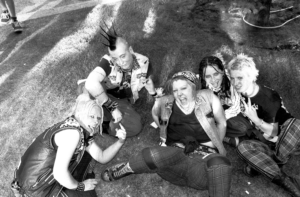
As Calgary’s very own Riot Grrrl renaissance continues to revolutionize local stages and DIY haunts, we glance back at a brief, hyper-local history. While feminist punk emerged many years before local bands overtly associated themselves with Riot Grrrl terminology, femme-fronted punk bands in Calgary have addressed themes like gender inequality and sexual violence, with varying levels of bluntness, since the ‘90s and 2000s. Some deem their approach “Riot Grrrl” upon reflection decades later, and many revere the modern-day Calgary bands carrying the punk feminist torch.
The 90s: Placebo and Pussy Monster
“There were a few women, but you could probably count them on two hands,” says Elescia Wojak, Placebo’s bassist. “Being a woman in the music scene back then, it was almost kind of an anomaly.”
Placebo was a femme-fronted punk band active from 1993 to 1996 in Calgary, led by the now-international folk sensation Leslie Feist. “[Feist] carved out her own territory,” says Brad Simm, a former contributor to CJSW’s VOX Magazine. “Maybe it wasn’t overtly a Riot Grrrl statement, but it was in there, that’s for sure.”
Placebo wasn’t as abrasive and candidly political as feminist punk can and has been, but there’s something to be said about the rigour with which they asserted their place. As present-day Riot Grrrl Helen Arias offers: “The action of taking up space and playing, despite prejudice, is inherently punk and inherently Riot Grrrl.”
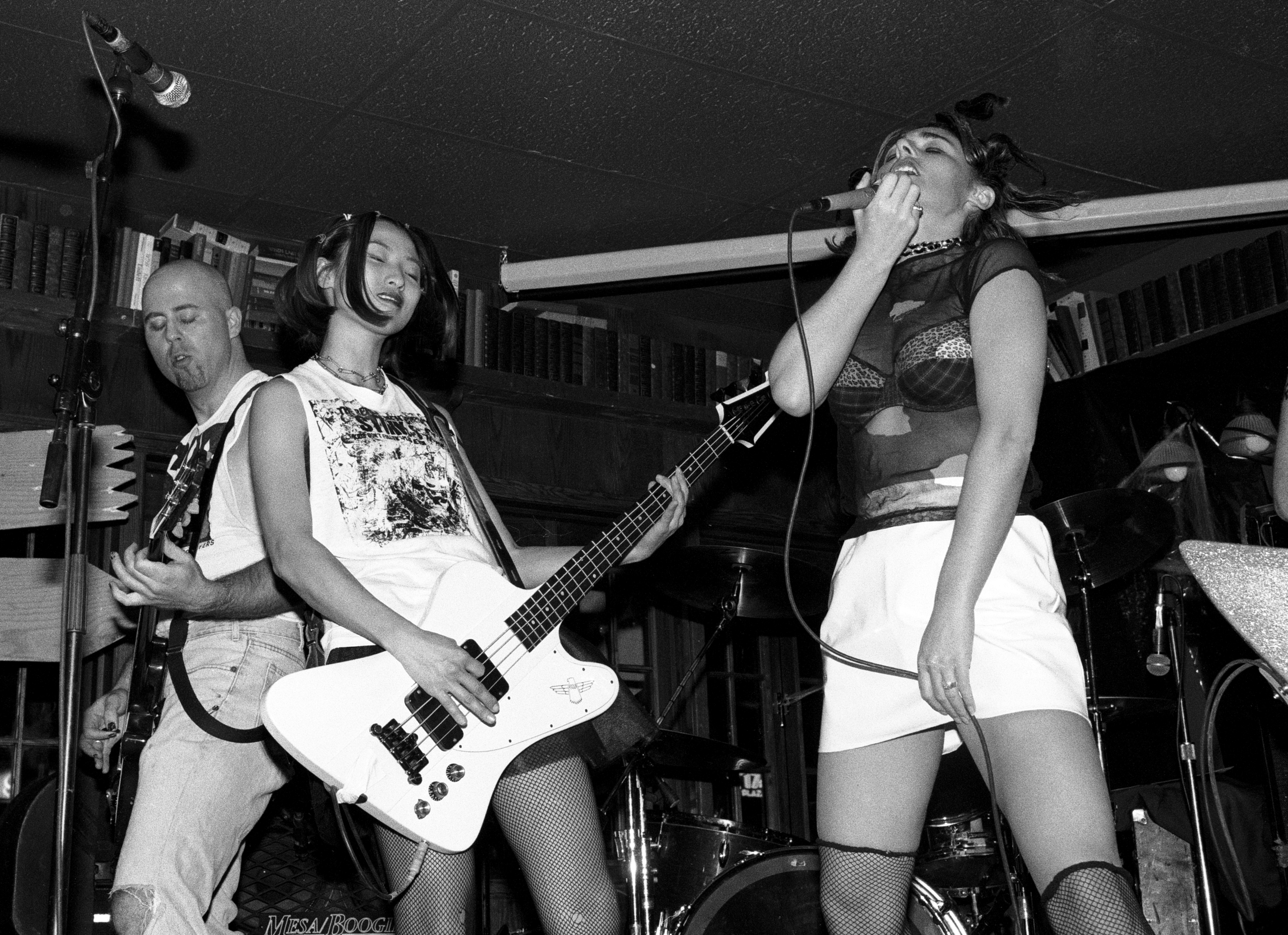
Fronted by Jean Choe and Val Smyth, Pussy Monster also formed in the early-to-mid ‘90s, one of the few femme-fronted acts in the scene (alongside Placebo, Lemonjade, Maud, and a few others). They often wrote about reclaiming control and denouncing sexist double standards, as is evident in their song “Modern Girls”.
While Riot Grrrl raged on in Washington around the same time, Pussy Monster were relatively unaware of the movement. “If we had been more aware of it we would probably have called “Modern Girls”, Riot Girls,” says Val Smyth. “It could practically be one of the anthems for that movement, then or now.”
Genre purism reveals itself an impossible and fruitless way forth — few bands are exclusively and irreproachably one thing, Riot Grrrl included. Perhaps, the genre’s titular riot, a hardcore push against sexism and the swell of women carving out room for themselves in male-dominated scenes, can very well be named retrospectively in cases like Placebo, Pussy Monster, and many more.
The 2000s: Honeyrocket, Kilbourne and Bogart!
“I think the impact of [Riot Grrrl] hit with bands like Honeyrocket, then Kilbourne,” says Arif Ansari, president and lead archivist at the Calgary Cassette Preservation Society.
Honeyrocket, who She Rox dubbed “forerunners” in Canada’s Riot Grrrl movement, turned into Kilbourne around 2004. Throat-ripping vocals on songs like “the revolution of less” and “Orphanage of the Future” reverberate with a rawness that feels acutely Riot Grrrl.
“Maybe we’re projecting, but we like to think we hear the roots of the current crop of excellent femme-fronted Calgary hardcore bands in Kilbourne,” says Ansari.
Bogart! was active until 2008, fronted by Miesha Louie. “Riot Grrrl was a big part of my formative high school years, and was sort of the tipping point of me finding my confidence as a performer,” says Louie. “I didn’t see any Indig girls anywhere — the closest I came was Honeyrocket, fronted by Fillipinx sisters Trez and Fannie. Trez, whether she knew it or not, became my mentor.”
Louie now runs BAM! Camp Calgary and mentors modern-day artists like Rebel Grrrlz, an active local band who met and formed at the music camp for girls and gender-expansive youth.
The 2010s: The Shiverettes, Femme Wave, and Sled Island
When she first joined the Sled Island team in 2013, present-day director Maud Salvi’s first pick for a guest curator was Kathleen Hanna, pioneer of the Riot Grrrrl movement. While Hanna had to cancel due to health complications, the festival’s fondness of grrrl bands continues, having booked over the years bands like Mannequin Pussy, The Coathangers, Birds of Prrrey and local Riot Grrrl acts such as Toxic Fem, Rebel Grrrlz and Perra.
“There’s a lot of overlap between Riot Grrrl values and that of Sled Island, so it makes sense that we end up booking a lot of these acts,” says Salvi.
Around 2013, musicians and organizers Hayley Muir and Kaely Cormack started up their feminist punk band, the Shiverettes. While the Me Too movement was first garnering global attention, the Shiverettes put out songs like “Incel”, “Shout Your Assault” and “Dead Men Can’t Cat Call” that overtly denounced exclusionary spaces and sex-based violence.
“Being a woman in a band was fucking hard, and people said stupid stuff to us all the time,” says Cormack. “Even if we didn’t start off political, being in that space politicized us and forced us to respond fiercely.”
“Always grateful for the women and non-binary folks who came before us for paving the way and normalizing certain things,” says Muir. “I’m very aware of the privilege that it is to be able to speak, at least at that time, freer in our own way and more direct.” In terms of other Riot Grrrl acts around this period embracing unfiltered commentary, Arielle McCuaig’s 2011 band Rape Revenge comes to mind instantly.
In 2015, Muir and Cormack set out to put on a ‘no boys allowed’ show. The show quickly turned into a multi-day intersectional feminist arts festival, Femme Wave, which included sound production and recording workshops to help bring more women and non-binary artists into the scene.
Present day
Nowadays, our scene boasts some of the most forthright, powerful and politically outspoken bands that the city has seen.
“A lot of Riot Grrrl is about sexual trauma and violence, and writing through catharsis,” says one of Perra’s lead vocalists. Perra is also vocal about issues surrounding harm reduction and migrant rights, having recently performed in a series of benefit shows denouncing ICE, with proceeds going towards legal representation for detainees.
“Punk music is about being a part of the community and supporting others that are less fortunate,” says Medusas’ Grace Johnston. Prior to disbanding, Medusas also performed at fundraisers, most recently for science peer tutoring.
“We always had that Riot Grrrl influence. Bringing up social causes and political issues was always something we wanted to speak on and be loud about,” says Finley Lawrance, Rebel Grrrlz’s bassist.
While earlier approaches were more subliminal, modern-day Riot Grrrl bands continue to push the needle even further by denouncing more intersectional political issues, or in Perra’s case performing in front of a quilt that reads “DEAD MEN DON’T RAPE”.
“It’s great that now we just call it what it is, because the point is to make people uncomfortable,” says Placebo’s Wojak.
Identifying with a feminist punk movement that originated in the ‘90s involves some degree of looking back to the artists who came before. Still, the ‘90s weren’t all that long ago, meaning that those who paved the way can now appreciate firsthand the modern — and often blunter — music and organizing that still bleeds from their efforts.
“This Riot Grrrl renaissance happening in Calgary right now is everything I’ve ever wanted,” says Miesha Louie.
Pussy Monster’s Jean Choe admits that she hopes that one day Calgary’s modern Riot Grrrl bands will cover their song “Modern Girls.” “There were and still are many things to be fighting for,” says Choe. “It’s wonderful to see music continuing to be the tool to combat the madness.”
“There is something timeless to the Riot Grrrl spirit,” says Maud Salvi. “As long as we need feminism, Riot Grrrl will be relevant.”
Zine Culture
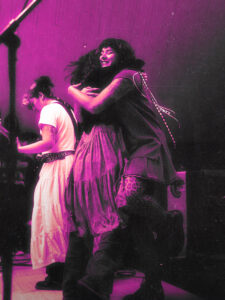
Along with other forms of cultural production like DIY shows and activism, zine culture has long been an important practice for Riot Grrrls through the ages.
“In Riot Grrrl in the 90s, [zines] were a way of sharing information about your scene, about safe people, about dangerous people, about yourself and your own experiences to show other people that they’re not alone in theirs,” says one of Perra’s vocalists, Helen Arias.
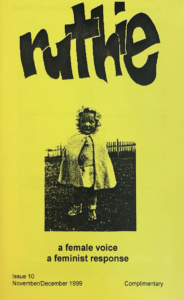
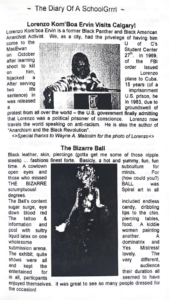
Just one of the zines circulating around the ‘90s in Calgary was titled Ruthie, subheaded as a “female voice / a feminist response.” Ruthie frequently published topics relevant to Riot Grrrl, such as the column “The Diary of A SchoolGrrrl,” lists of feminist values, information on sexually transmitted diseases, and written selections by femme writers.
Then & Now
In a conversation about the powerful feeling of asserting your place despite being one of few women in the scene, an earlier femme-fronted punk musician mused the following question for modern-day Riot Grrrls:
Wojak (Placebo, 1991-1993): The girls that are playing punk today, do they still feel that raw power when they play? Do they feel strength coursing through them, that they could do anything, that they could tear somebody to shreds?
Kaley (The Shiverettes, 2013-2019): Big time. I miss the power I felt on stage, I carry it with me to this day. It changed my DNA, and it’s made me a stronger person.
Grace (Medusas, 2023-2026): Yes, I do. 100 per cent. It’s a bit different now, because thankfully there’s more girls and femme people in the punk scene. But there’s still so much toxic masculinity, and I’ve had to call out a lot of dudes.
Scarlet Hegel (Rebel Grrrlz 2023 — present): As a female drummer, there’s not that many of us still. I’m good at what I do and I kick ass. It’s really powerful.
Helen Arias (Perra, 2024 – present): Yes. Performing is extremely vulnerable and powerful, there’s a suspension of disbelief and power dynamics, like drag, like BDSM. It’s awful and great, and every set rips me to shreds. It’s like a cannibal ritual. We’re invoking every feminist performance artist before us who used her body to prove all of it is a farce and an act. It’s praxis.