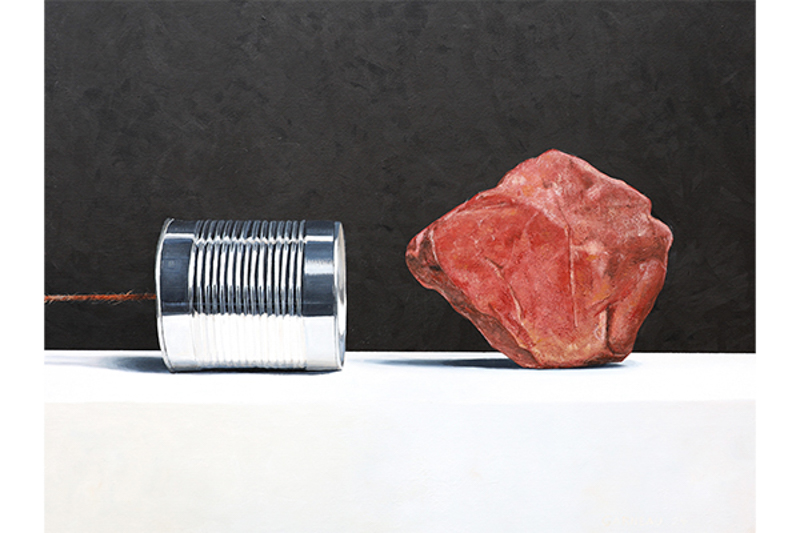
A fly rests on a glistening, voluptuous orange peeled apart. A tin can with a string leans toward a jagged red rock. A bison skull is shrouded in clear bubble wrap. Books sit in stacks or stand alone, bound tightly with strings or a chain. A Métis sash is wrapped tautly around a Winchester rifle once issued by the North-West Mounted Police, surrounded by swirling bead-like dots.
Unsettling juxtapositions like these run throughout David Garneau’s two-part exhibition, Dark Chapters and Reading the Ruins. Across these interconnected paintings, Garneau reclaims the still life as a critical art form, one capable of holding the weight of Indigenous histories, colonial violence, and cultural persistence. His paintings place everyday objects alongside sacred objects, such as the Métis sash, burning sweetgrass, bison bones, and grandfather rocks, as well as artistic ones like brushes, paint tubes, and gallery plinths.
Garneau’s Métis heritage informs this vast project. Indigenous artists have long repurposed European trade materials — glass beads, silver, wool, buttons — into culturally specific forms shaped by continuity, adaptation, and survival. Garneau extends this lineage in paint, reconfiguring the visual language of the European still life and bending its familiar arrangements toward Indigenous ways of seeing.
DARK CHAPTERS
In Dark Chapters, Garneau introduces a cast of recurring characters that carry symbolic weight. Rocks, often referred to as “Grandfathers,” represent Indigenous ways of knowing, being, and doing. They function as quiet knowledge keepers, anchoring the compositions in a worldview that predates and exceeds colonial frameworks. In contrast, books appear as emblems of Western academic authority, repositories of institutional knowledge that have historically excluded or misrepresented Indigenous voices.
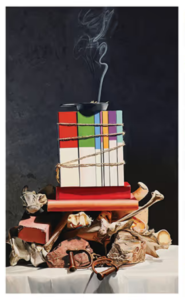
Tension between forms is a central drama within Garneau’s paintings. In works such as Dark Chapter, books are stacked, bound with twine, and rest upon ruins, evoking an archaeological dig. Amongst the pile are bones, bricks, and handcuffs. In other paintings, books are clamped in vices or suspended by a string, symbolizing colonial violence through the constraining or controlling of knowledge. These are not neutral objects; they are its ruins.
In Garneau’s paintings, cultural artifacts such as the Métis sash, sweetgrass, stone tools, and bison bones are frequently juxtaposed with symbols of colonial modernity, such as bricks, chains, and bubble wrap. These create compositions that feel at once rooted and unstable. The effect is not just contrast, but entanglement. Indigenous and colonial histories are shown to be inextricably linked and in tension.
Institutional containment is both visual and conceptual. Objects appear carefully arranged yet constrained, as though held within invisible systems of control and violence. And yet, Garneau resists any reading of these works as purely oppressive. His use of vivid light and luminous colour imbues the compositions with a sense of vitality. Even in scenes of tension, there is resilience, beauty, and continuity.
READING THE RUINS
Reading the Ruins expands the frame outward. In this exhibit, Garneau engages directly with historical artifacts from the era of the North-West Mounted Police, developed in collaboration with archival collections. By painting buttons, insignia, and uniforms associated with this period and displaying them alongside the actual objects, he strips them of their institutional authority, leaving them in ruins.
The effect is striking. Museum artifacts, often presented as neutral carriers of history, are revealed instead as instruments of colonial control. This is particularly evident in Garneau’s treatment of the buffalo coat, a garment worn by the North-West Mounted Police. Rendered with heavy, tactile paint, the coat becomes a symbol of contradiction: a tool of colonial enforcement made from bison hides, an animal central to Métis and First Nations culture and nearly eradicated through colonial policy.
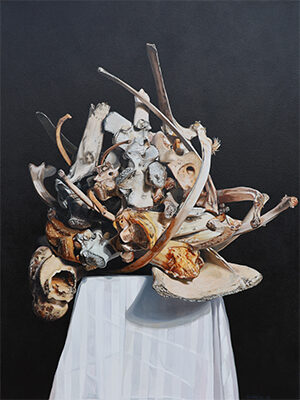
Such monumental losses are explored in other works, such as The Troubling Ability to Paint During Genocide, where Garneau confronts the uneasy position of an artist to create in a world marked by ongoing conflict. By referencing contemporary crises in places like Ukraine and Palestine, he questions the ethics of aesthetic production amid such despair and destruction. His own ruins serve as a memento mori, a reminder that all empires, no matter how powerful, eventually collapse. But other works, such as Future Portrait of the Artist (a skull on a plinth) and Visiting a Relative in the National Gallery (a large display case shrouded in a white cloth), also remind us that ceremony, knowledge-keeping, and mourning play a significant role in moving forward as artists or global citizens.
Most profoundly, across both exhibitions, the rock persists, not only as grandfathers but as witnesses. Silent and enduring, they observe the cycles of violence that define both past and present struggles. In this way, Garneau skillfully transcends the still life’s apparent stillness. These are temporal works, holding multiple histories in repose and unrest. What emerges is an extraordinary body of work that will engage profoundly and viscerally with truth and reconciliation.
Dark Chapters and Reading the Ruins are on view at the Founders’ Gallery until August 30, 2026. Find out more at founders.ucalgary.ca.