Before modernism, painting was the noise of culture. Now the noise is everywhere, a constant stream of
images, data, and sensory input. Amid the algorithmic churn, paintings offer a different rhythm. They ask us to pause, linger, and enter spaces with undulating textures, luminous colours, and expressive gestures.
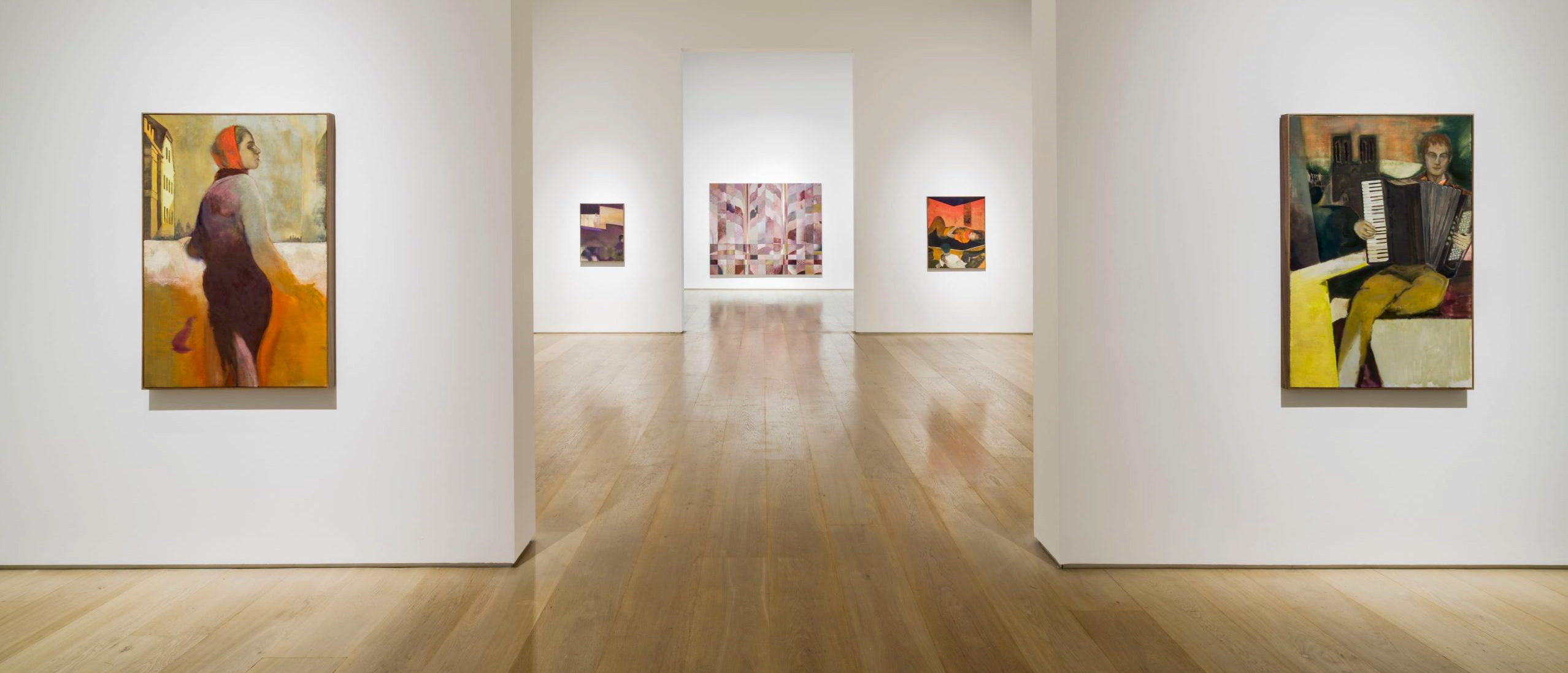
Across four solo exhibitions at the Esker Foundation, this sensibility emerges in paintings abundant with warm palettes, surprising contrasts, and intimate scenes.
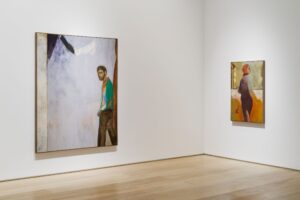
Justin de Verteuil’s sie will / muse. zur marionette opens a window onto other realms. In works like Planet Caravan, a body hovers magically against a black, silhouetted tree, set within a sumptuous, fiery sky. A tautly stretched hammock transforms into angel wings as the figure, contorted and in motion, struggles to keep from falling — or to find the strength to fly away. de Verteuil’s oil paintings are luminous and sensual vignettes that respond to tensions between ambiguity and the mundane.
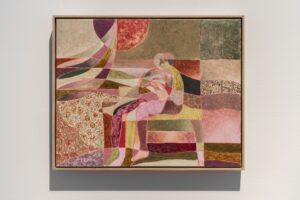
Alexandre Pépin’s Lavender shifts the focus to paintings that unfold slowly and reveal ambiguity, joy, and subtle tensions between geometry and traced lines, weaving abstraction and figuration into a single web. Two figures entwined in tall grass, a solitary figure in an ornate landscape, or lovers merging in a chair all evoke intimacy in everyday gestures. Pépin, who is French-Canadian, draws inspiration from Byzantine and Early Renaissance frescoes to portray moments of queer intimacy and spiritual contemplation.
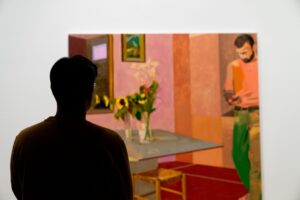
Anthony Cudahy’s metronome yawned puncuates white walls with warm fuschias, cool yellows, and bright greens. Breathtakingly tender, his paintings coax us to gaze upon intimate scenes intertwined with symbols or archival fragments. Cudahy, who is Florida-born and Brooklyn-based, captures fleeting moments where figures rest, embrace, or make love. His unexpected shifts in shadow and colour ask viewers to slow down, linger, and meditate on how painting can lovingly render human interactions. In Double Readers (mooncycle), one female figure, awash in warm browns and oranges, begins to merge with a ghostly female as they stare into a black abyss punctuated by vibrant green. Crescent moons in the upper right corner read like stuttering text, a subtle prompt to slow down and observe.
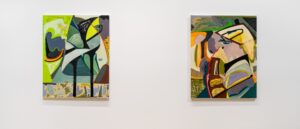
Magalie Guérin’s Orange to Rattle draws viewers into her intimate, punchy abstractions. Guérin, who paints on surfaces marked by slight ridges or shallow pathways, uses a palette ranging from chartreuse green, burnt umber, and intense orange to textured surfaces and geometric shapes punctuated in black, white, yellow, and violet. Slippage occurs in many of her paintings where ambiguity shifts to something familiar, like a tree or vase, but you can never be quite sure. In one piece, it’s hard not to see an urban landscape lined with modernist trees and a sky awash in green and yellow hues. Montreal-born but based in Texas, Guérin creates her own painterly worlds filled with shapes that are concrete and unknown. Her compositions move in their own rhythm, inviting viewers to dwell inside these most curious constructions and to delight in the rigorous interplay of colour, texture, line, and form.
What binds these exhibitions is not palette, style, or subject matter, but a sustained engagement with attention, perception, and intimacy. Each painter asks the viewer to slow down, linger, and revel in moments that might otherwise pass unnoticed. In doing so, they remind us that paintings can align with our deepest longings and offer a fleeting glimpse into what it means to be luminous and profoundly human.