Long before this year’s lineup announcement officially arrived, I noticed small woven threads of conversation surfacing repeatedly across my feed. While Calgary hosted the Canadian Folk Music Awards, I found myself drawn to the quiet conversations unfolding around the Calgary Folk Music Festival and the broader culture surrounding it.
It wasn’t just local discourse, but a kind of national reverie and recognition stretching across timelines from different parts of the world.
People were talking about the festival well before the lineup announcement. Industry was talking.
What was particularly interesting was that this wasn’t buzz driven by leaks or spoilers. Members of global music scenes were giving Calgary Folk Music Festival its flowers in the dead of winter.
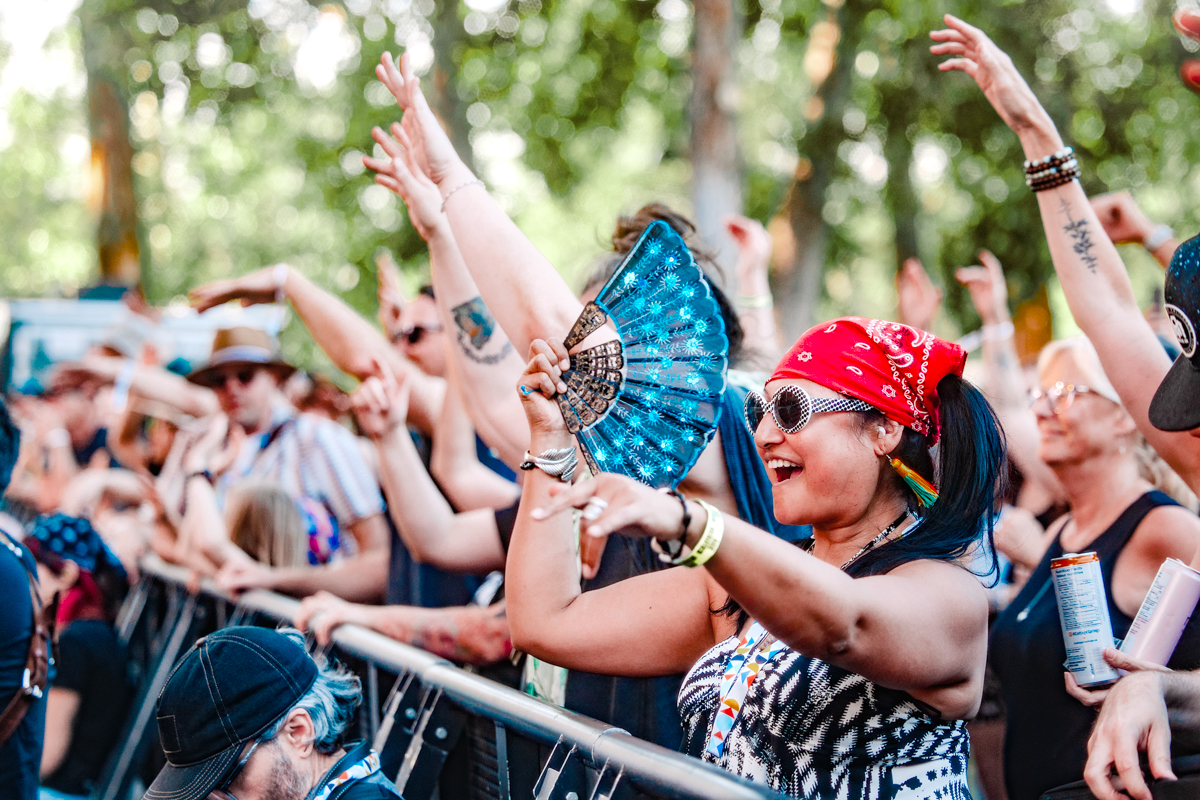
Stories about volunteering surfaced. Stories about attendees discovering artists they had never heard before. Tarp culture. Workshop collaborations. Summers spent along Prince’s Island Park. The interwoven Threads felt less like promotional hype and more like collective remembering, like one long tarp.
Here’s the thing: the discourse wasn’t heavy. It wasn’t the kind of rage-bait conversation that dominates online spaces now. It felt softer than that. More communal. More familiar. The kind of conversations that happen when people are talking about something stitched into the emotional fabric of a city.
Over the last couple of years, Threads, Meta’s newer social platform, has quietly become an unexpected gathering place for cultural conversation. Less polished than Instagram and less heated than X, the platform feels communal, conversational, and immediate.
By the time the official lineup finally arrived this year, the emotional groundwork already felt laid organically.
For this story, I poked the algorithm a little bit and, with over 1,000 views in less than 24 hours, stories and accounts quickly surfaced to share their thoughts about the festival.
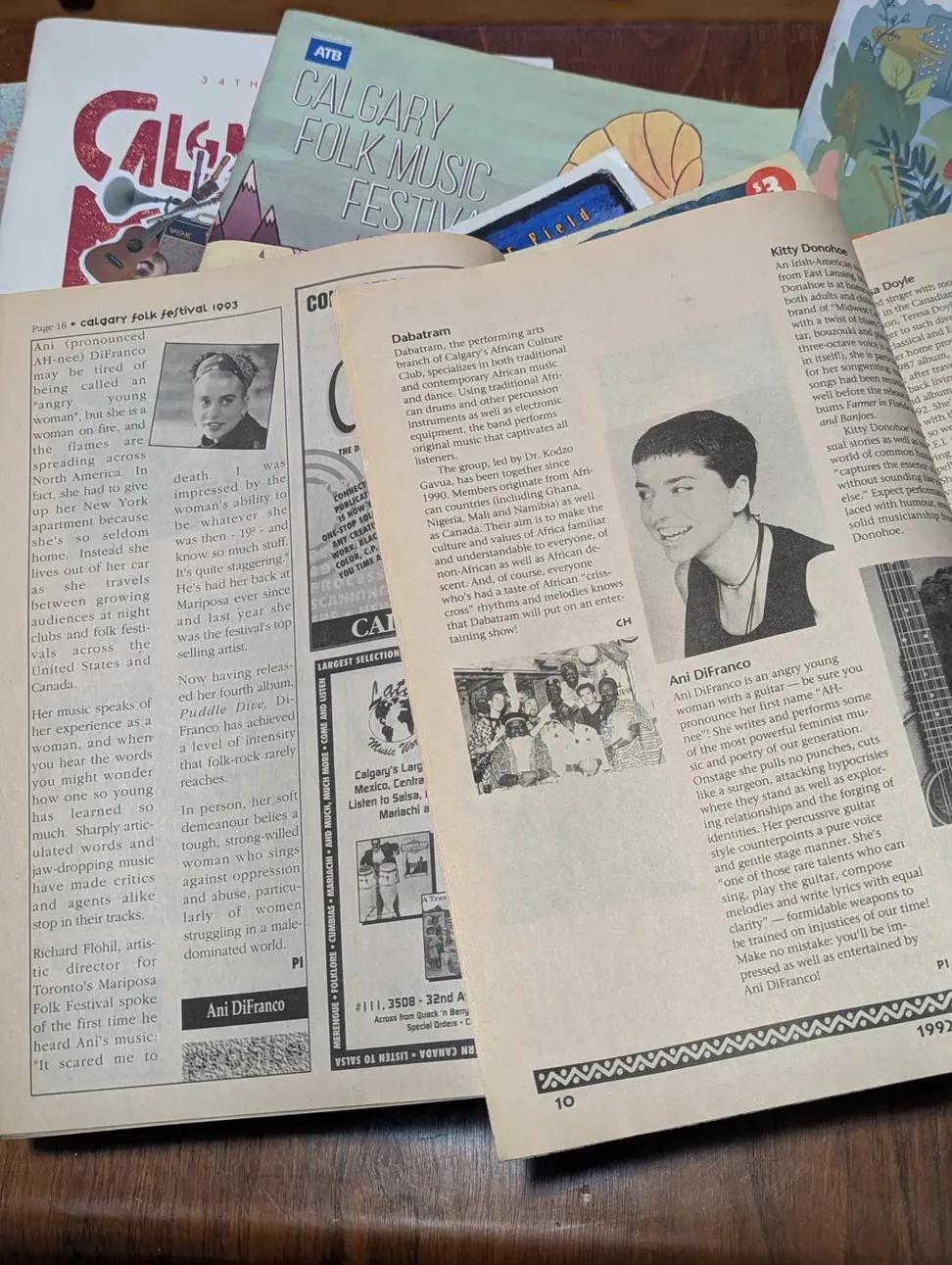
Calgary’s Rick Thompson (@citizenfreak), a self-described plant-loving vinyl record junkie whose practice on Threads is dedicated to documenting an extensive vinyl collection, shared archival festival programs from the early 1990s featuring Ani DiFranco alongside Calgary African performance group Dabatram, a subtle flex of a reminder that Calgary Folk Fest’s global instincts are not entirely new.
Nancy Lusty (@nancyjlusty) wrote about a dearly departed friend who proudly volunteered security every year because it meant “free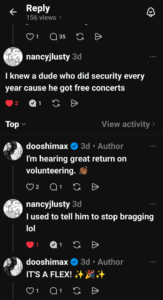 concerts.” Scotty (@scottymcarthur) described Folk Fest as “the surprise of being blown away by someone whose work I don’t really know,” adding that “my kid has volunteered a few years in a row and is flying back from university summer job in Ontario to do so again because she loves it so much,” while Hailey Seidel (@haileyseidel) called the festival “a great example of how fantastic the city is.”
Again, the comments felt less like promotional hype and more like collective remembering.
Following this year’s announcements, there has been excitement around the return of Mariel Buckley following her JUNO Award win for Contemporary Roots Album of the Year only weeks earlier. There was curiosity around emerging Alberta artists and enthusiasm for returning favourites. But what truly tipped the Folk Fest tarp this year was the announcement of Killer Mike, the Grammy-winning Atlanta rapper, activist, and one-half of politically charged hip-hop duo Run the Jewels, who was brought in as a replacement for The Psychedelic Furs after they were originally announced as part of the 2026 lineup.
Suddenly, a bit of online buzz was aflame: “How is Killer Mike folk?”
For Kerry Clarke, the festival’s programmer, the answer feels surprisingly simple.
“For me, folk is about storytelling,” Clarke explained during our conversation. “People told stories and still tell stories through hip-hop and urban music in ways that they couldn’t through other styles of music.”
That philosophy sits at the heart of Calgary Folk Music Festival’s legacy.
Clarke points to the deeper musical lineage connecting African musical traditions to blues, jazz, funk, and eventually hip-hop. In that context, artists like Killer Mike do not exist outside the boundaries of folk traditions; they are part of their ongoing evolution.
“The songs are still there. People are writing original songs. That’s what’s important to us,” Clarke said. “It’s about storytelling.”
What also sets the Calgary Folk Music Festival apart from many traditional festival models is the exquisite nature of its programming. Artists are not simply flying in, performing a quick set, and disappearing back into the touring machine. The festival’s workshop structure intentionally invites musicians from completely different genres, cultures, and traditions to collaborate in real time over the weekend.
A blues musician may suddenly find themselves sharing a stage with an Indigenous drum group. A hip-hop artist may drift into conversation with a folk songwriter from the opposite side of the world. Jazz musicians weave themselves into global rhythms. Sounds bend. Genres expand and loosen.
“The artists need to participate in a collaboration,” Clarke explained while describing the programming process.
The result feels less like a collection of performances and more like a living tapestry unfolding across Prince’s Island Park over four days.
In retrospect, this is what the Threads conversations were circling around all along. Not genre purity. Not nostalgia. But the atmosphere. The discovery. The ever-evolving community. The feeling of gathering beside the river with thousands of strangers and somehow still feeling familiar there.
Maybe Folk Fest remains “folk” precisely because it continues flowing and weaving alongside the people who return to it every summer, tarp or no tarp.