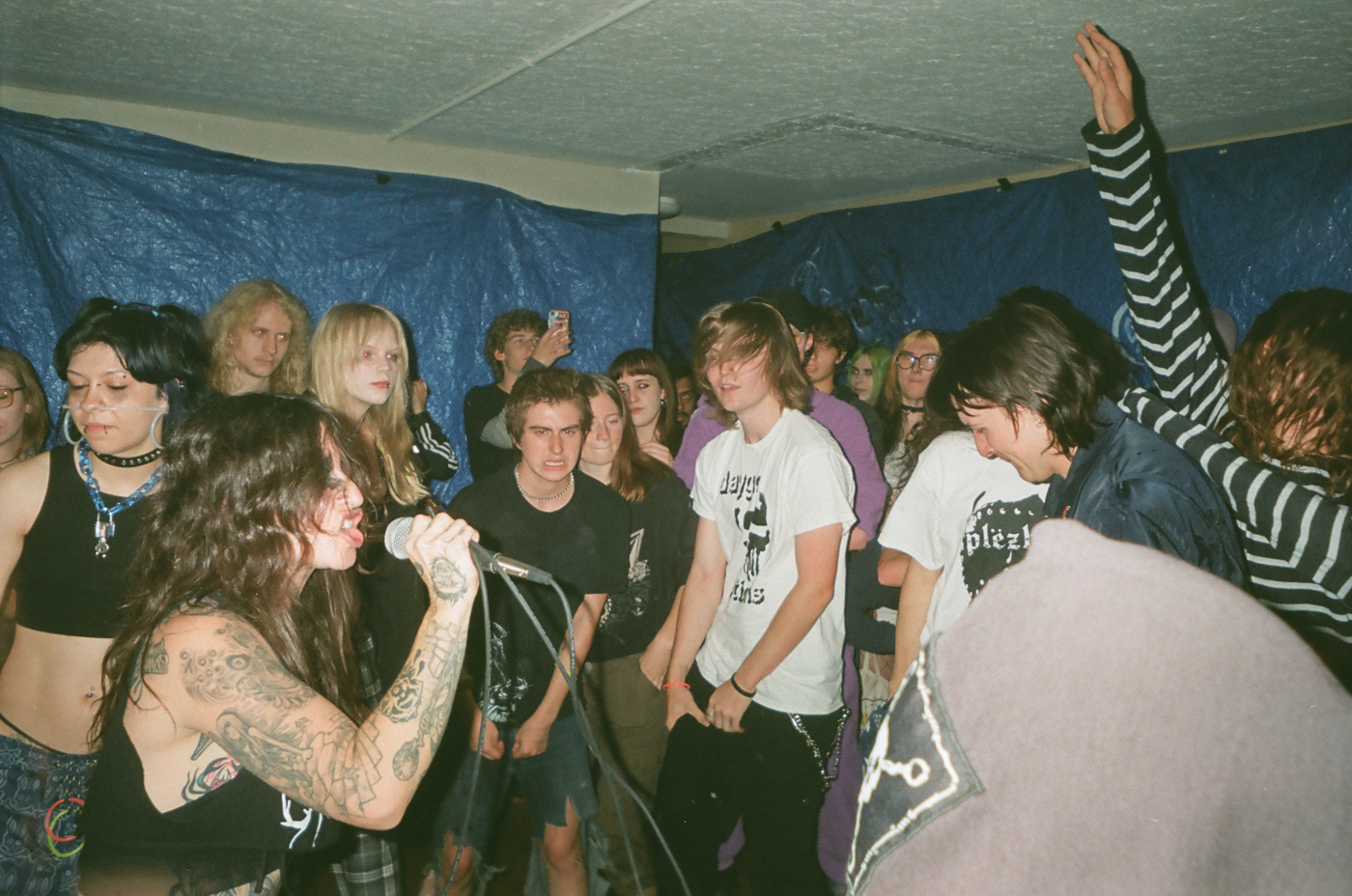
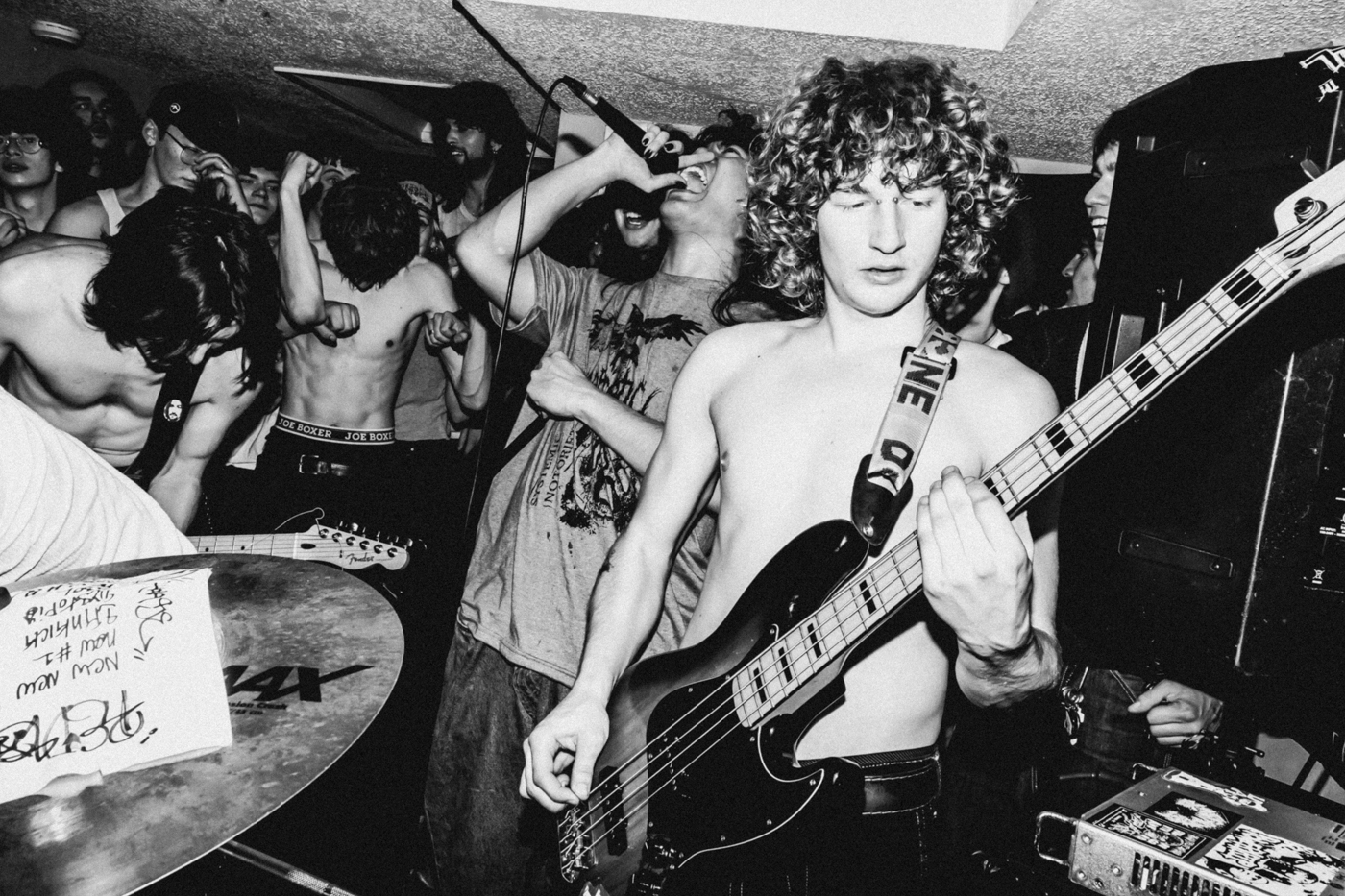
Behind the walls of an unassuming suburban house in Northwest Calgary, the opening night of a punk and grindcore festival dubbed Sonic Terror rages on. Unbeknownst to most passing through the residential neighbourhood on a warm Thursday evening, the makeshift venue emitting a politely muffled stew of crashing drums and bass feedback is actually bursting at its seams with over a hundred tight-knit punks. The crowd inside has gathered to see travelling hardcore bands from across North America — and greet them with a basement-wide mosh pit contained by walls slick with sweat-turned-dew.
For those who know where to look and who to ask, Calgary’s house punk show scene is both sporadic and thriving, chock-full of energetic punks with a deep reverence for the DIY ethos that thrives in non-traditional venues.
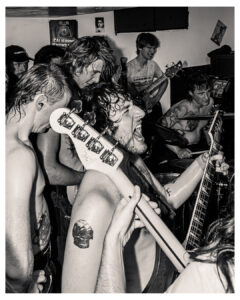
A 1984 documentary titled Another State of Mind visits a historic local punk house known as The Calgary Manor. A young man swings open the door, offering the cameramen a bowl of chilli in a thick Canadian accent — a warm hospitality that touring hardcore bands still feel from Calgary’s underground scene.
Nowadays, drummer for local fastcore band Red40 and the organizer behind Horrible Existence schedules shows with bands passing through the city in mind. He was one of the organizers responsible for the Sonic Terror festival, which saw bands from Los Angeles, Portland, New York, Winnipeg and more playing versus sets on a regular weeknight.
“It’s a small world, once you really get into underground music. Either we meet them on the road, or people have told them about us, or vice versa,” says the organizer, explaining how out-of-town bands know where to find house shows in Calgary without traditional promotion methods.
Today, Calgary’s “punk houses” are somewhat ephemeral, changing names every few months and often settling in on the cusp of a property’s scheduled, or accidental, destruction.
Up until its final show in 2025, Half Rabid House was one of the most popular choices for local house punk shows post-COVID. The name came from half of the house being “rabid” — the basement where chaotic shows were held — while the other half was simply someone’s home.
After Half Rabid was sold as a tear-down for its lot located near Briar Hill, local punks gave it a warm goodbye. “We had the final show and tore the whole thing out. There was almost no drywall left in the basement by the end of it, all the walls were painted,” says Horrible Existence’s organizer. “That house got gutted.”
“There’s a huge influx of historical houses that are being destroyed for the development of luxury condos,” says Elliott Platt, a former house punk show host (also known by his artist name ElyOtto). “[Some] of these shows are one last hurrah, a way to celebrate the house while consuming it in some way or another.”
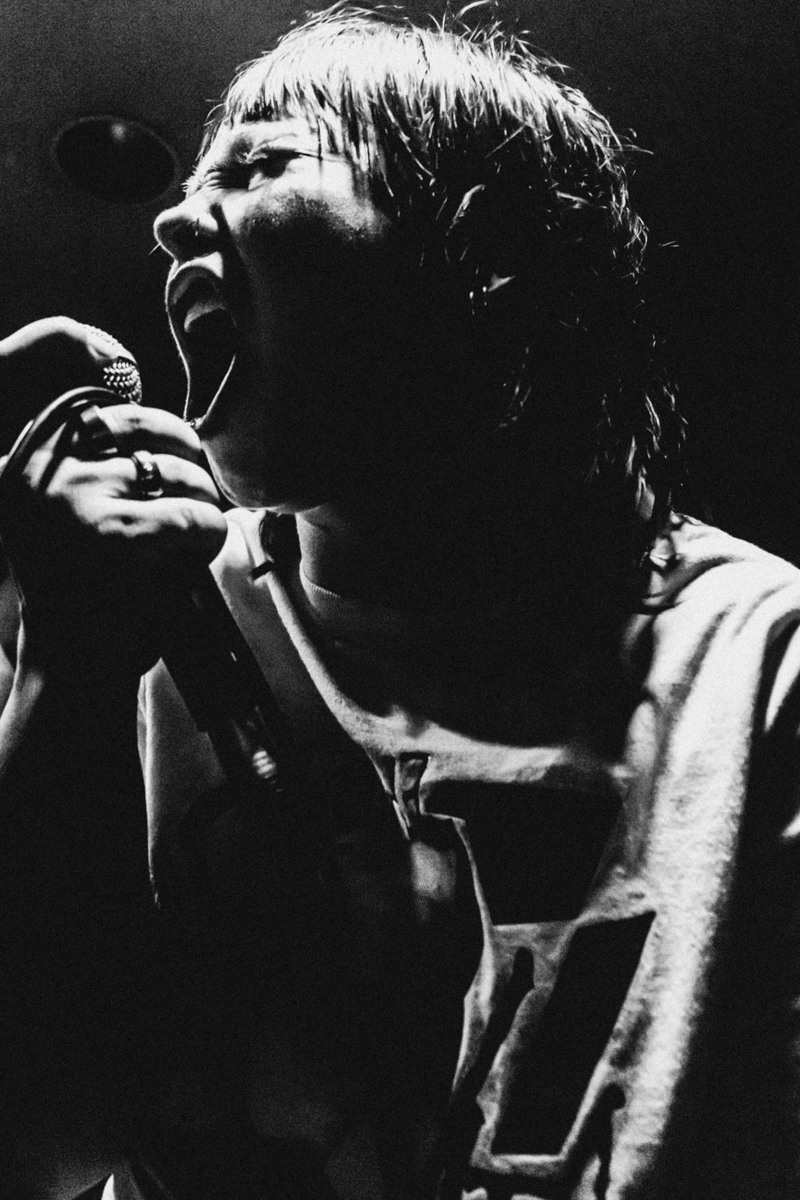
Another recent cornerstone of the scene was Piss House. The original one succumbed to a house fire around the same time as Half Rabid House was sold, a tragedy caused by a cigarette rolling off of a full ashtray and onto a couch. Piss House 2 popped up to fill the void, but was demolished before any shows could take place. Piss House 3 is now standing near Varsity, and has seen punk bands from all over, including P.L.F. from Texas and Winnipeg’s Nuclear Man. Nowadays, a house called Chetlandia is one of the most frequented spots for punk and grindcore shows, and was the venue for the first night of Sonic Terror.
Some say that having to repurpose a home into a stage is emblematic of the culture rather than an infrastructure kink to be ironed out. “There’s no real way to design for punk rock,” says Cecilia Sereda, a writer published in the architectural journal ARCADE. “How it acts as a subculture is informed by the fact that it is remaking these spaces that were not originally designed for it to be there.”
Local musician Conor Nagel lived in a punk house called Garbage World (GW) on Edmonton Trail about a decade ago, and he says that a more rundown property can mean more freedom to customize the space and host shows. “[GW] was, structurally, such a terrible fucking house. There were centipedes and spiders and it was not a very nice place to live,” he says. “But with that, you could kind of not care as much — you could tag the walls, you could throw parties whenever. [Living there] was probably the most liberating thing that I ever did.”
The guitarist and second vocalist of a local experimental emo-violence band called Chalkeater says that there’s something cozy about playing a house show. “It feels more like a party and less like I’m here for work,” says Lola (A.K.A Babayaga). “It’s more familiar, more friendly.”
Another reason that houses are especially well suited for hardcore punk performances is that shoulder-to-shoulder pits and energetic two-stepping tend to make owners of licensed music venues sweat a little.
“It’s really hard to find places that’ll let [hardcore punk bands] play,” says punk and former house show host Lauren Stein. “Many venues don’t want you to mosh because they don’t want anything broken or for anyone to get hurt.”
Stein and Platt long hosted shows at their home in Ramsay, which they cheekily dubbed “The Ritz.” In 2024, the Ritz held a show called “Punks versus Computers” where both punk bands and electronic artists played in succession to a delighted crowd at maximum capacity.
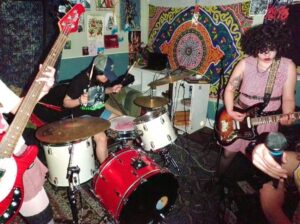
“[House shows] can be so much more high energy,” says Horrible Existence’s organizer. “It’s kind of cool to be able to fully put those things on yourself and play by our own rules.”
While he isn’t able to host shows at his place, this organizer still welcomes in the community-oriented spirit that surrounds the actual shows: “Our house has pretty open doors; there’s always people here. We’re out here working hard, making flyers, jamming.”
While some underground subcultures are simply lesser known because of their niche target audience, house punk shows are somewhat purposefully buried.
“It keeps the roots of punk and hardcore and grind almost sacred,” says local punk Jules. “It keeps the scene more authentic, and more protected in that regard.”
That kind of protection often includes vetting the politics of those frequenting the scene. “Punk means you’re standing up for what’s right and you’re standing up for people that are vulnerable, for people that don’t have a voice,” says Jules.
These DIY shows aren’t advertised publicly, so finding them relies almost exclusively on asking a punk. Yet, gatekept access to these shows is a concern swiftly dismissed by those keeping the scene alive.
“I think if you care about the music enough, you’re gonna care more about the quality of the people that come than the quantity,” says Platt. “If you want to become part of the punk scene, you have to make friends with punks, and then you won’t have a problem with inaccessibility.”
So where do you start? Local punks point to a few avenues for meeting likeminded folks and getting involved: attending punk shows happening at traditional venues, being a part of tangential communities like skateboarding or visual art, or volunteering with organizations like Good Neighbour or Street Cats YYC.
“It finds the people who really need it,” says Horrible Existence’s organizer. “If you’re the kind of person that’s gonna really enjoy [house punk shows], you’re gonna end up in the right places, meet the right people, and find a flyer.”