In 1969, curator Harald Szeemann transformed the Kunsthalle Bern (a Swiss contemporary art museum) with his landmark exhibition, Live in Your Head: When Attitudes Become Form. He famously gave artists free rein to take over the gallery, disrupting preconceived notions about what curating art could be. This revolutionary show highlighted the importance of process, experimentation and the artist’s role in shaping an exhibition. Worlds, worlds, worlds evokes a similar vibe, where artist Curtis Talwst Santiago displays his miniature dioramas within a sprawling cardboard infrastructure that challenges conventional viewing.
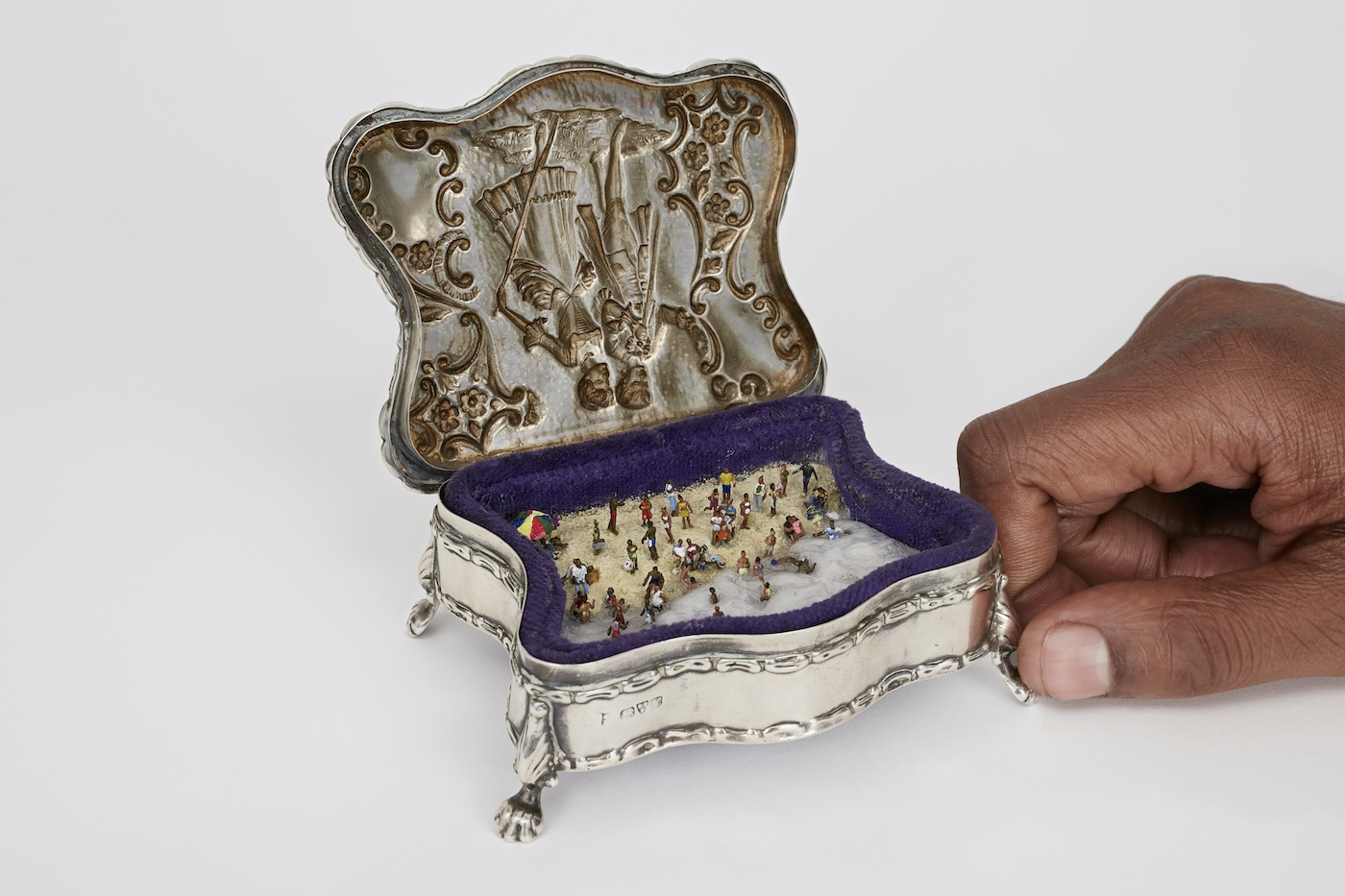
Housed in vintage jewel boxes, Santiago’s Infinity Series (2008 to present) are intricate dioramas that retell stories from personal memories, underrepresented histories and catastrophic events, ranging from police brutality to Yoruba myths. Born in 1979 to Trinidadian parents who immigrated to Edmonton, Santiago grew up immersed in Caribbean-Canadian culture. His early influences include music, dance and art, shaped by his family and community. Working across multiple media, he weaves historical, familial and speculative narratives into his works to question colonial frameworks and celebrate the diasporic imagination.
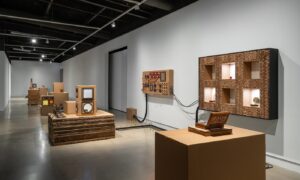
For viewers familiar with Santiago’s miniature dioramas, entering the low-lit gallery space will be unexpected and confronting. A sprawling cardboard network is stylized to evoke an analog data mainframe or a low-fi telecommunications network. Thick black cables snake across the gallery floor, plugging into stacked corrugated towers that resemble server blocks, while cardboard consoles on stands or mounted to the walls feature faux-circuitry, dials and a matrix of glowing red indicator lights.
We enter the gallery conditioned to view Santiago’s intimate worlds unhindered but find our bodies and sightlines disrupted and displaced by a network of cardboard constructions that require awkward and careful navigation. Cardboard, typically used to transport and protect objects, becomes the plinths, cases and shelves that frame the artwork. The sprawling cardboard functions as a conceptual and physical scaffold that transports viewers to a strange and unfamiliar land.
This engineered disorientation redefines how viewers must interact with his delicate and intimate worlds. By placing his jewellery boxes on and inside these unconventional structures, Santiago recontextualizes his dioramas. Safely archived inside keepsake boxes, these precious stories undergo a radical transformation. They now function as data nodes and microchips, plugged into a vast machine broadcasting narratives from the diaspora.

This shift comes into focus in the adjacent room, where two massive, cone-shaped megaphones, sculpted from layers of cardboard, face each other with large, gaping mouths that emit mechanical sounds. At each narrow end, the spiralling rings funnel the viewer’s eye down into cavernous telescopes containing brightly lit dioramas. Here, the architecture becomes a portal to another world, effortlessly harmonizing the sculpture’s massive scale with the intimacy of the miniature dioramas.
At one end, we discover the black silhouette of Anansi, the trickster spider spirit representing ancestral survival through displacement. At the opposite end, a matching conduit reveals a lone modern figure lying vulnerable amidst coarse gravel and rubble. Tethered together, they map a line of continuity across centuries, connecting an ancient story about resiliency and survival with the harsh realities of modern migration and human struggle.
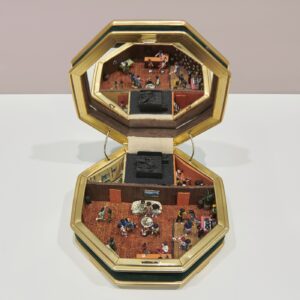
While the megaphone sculptures rely on physical architecture to broadcast this diasporic loop, another piece expands on this narrative using stop-motion animation. In a room tucked in the back corner, Santiago transforms a cowboy hat-shaped jewellery box into a cinematic vessel that explores faraway lands and distant planets. The curved brim floats like a capsule across a swirling turquoise sea, lands on a desert island flanked by miniature palm trees, and then soars like a lone rocket ship up through stars to other galaxies.
While the megaphone sculptures and animation offer clear points of transmission, the sprawling cardboard scaffolding reads as the peripheral noise of memory itself. It honours the diasporic imagination as inherently fragmentary, ever-evolving and resistant to tidy curation. Santiago channels the true spirit of When Attitudes Become Form by resisting conventional modes of display and redefining how an artist can reimagine their own work while transitioning their practice into a strange new world.
Curtis Talwst Santiago’s worlds, worlds, worlds is on at the Flanagan Family Gallery at Contemporary Calgary until January 3, 2027. 701 11 Street S.W.; contemporarycalgary.com