Calgary has never had a simple relationship with public art. Over the years, public installations have sparked spirited debates about everything from artistic merit and public spending to identity, politics and who gets to shape the city’s shared spaces. That tension is part of what public art is meant to be: it asks people to look, react, question and, sometimes, disagree.
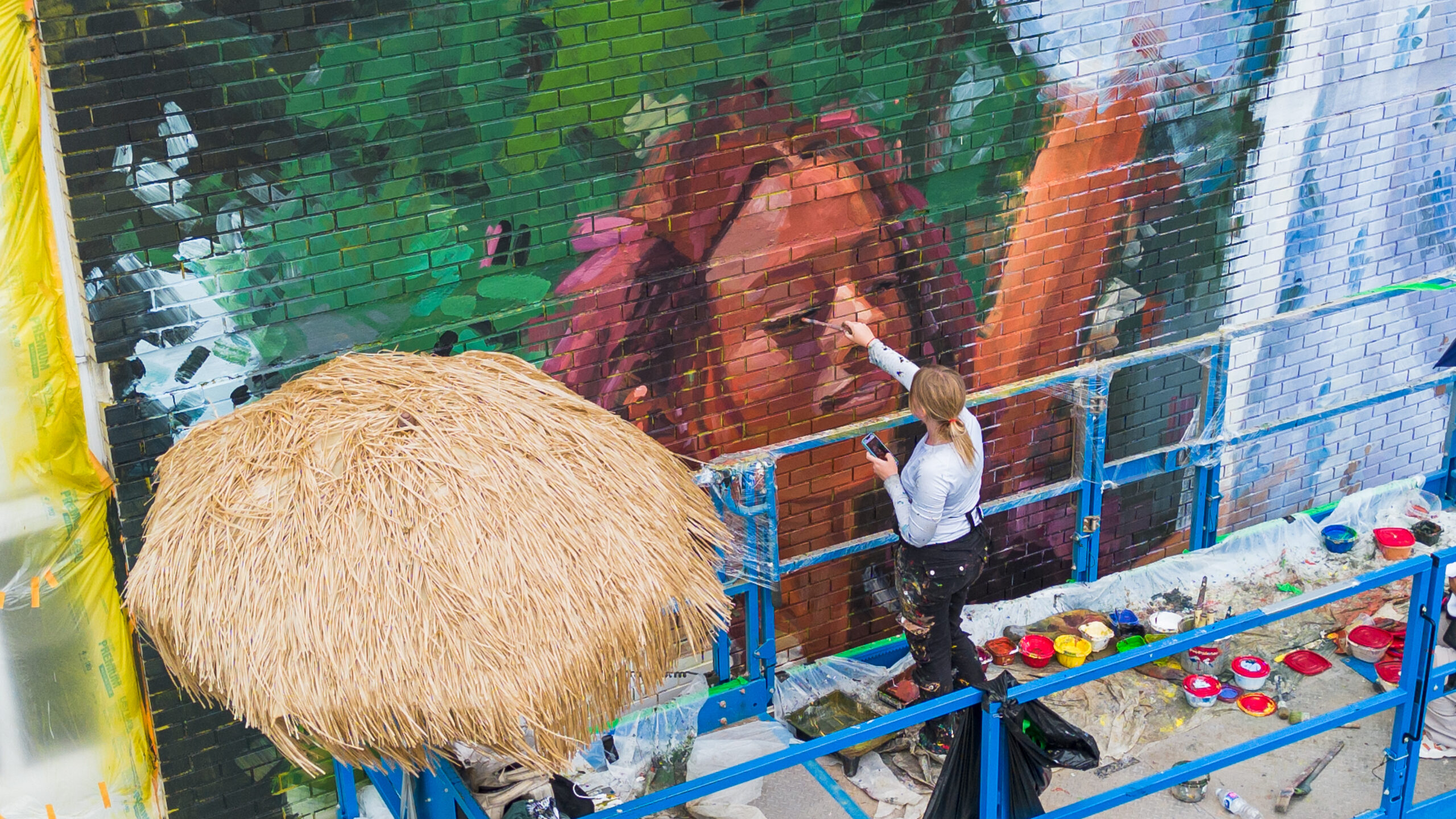
Against that backdrop, The Beltline Urban Murals Project (BUMP) has reshaped Calgary’s urban landscape, changing not only the city’s skyline but its relationship with public art. Since its launch in 2017, BUMP has transformed more than 160 walls and created over 460 public art installations across the city.
MORE THAN BEAUTIFICATION
To describe BUMP as an organization that paints murals is technically correct but incomplete. For Priya Ramesh, creative director of BUMP Festival, public art isn’t simply about beautifying walls. It’s about changing how people experience cities.
“If it simply makes a wall more beautiful, we’ve only scratched the surface,” she says.
Instead, she sees public art as a catalyst for conversations that connect people to neighbourhoods, local histories, new perspectives and communities they might not otherwise encounter.
“Muralism was never the end goal,” says Ramesh. “What we’re really interested in is how culture shapes public life.”
Since its launch, BUMP has evolved from a seasonal mural festival into a year-round public art organization working across sculpture, film, music, conferences, youth mentorship, placemaking and public interventions.
“BUMP is an urban art movement disguised as a mural festival.”
SLOWING DOWN
For Chloe Chan, marketing director of BUMP Festival, the impact of public art is often found in everyday moments.
“When I think of Calgarians, I imagine someone running to the CTrain,” she says. “People feel the pressure to keep up, to catch up, to go, go, go.”
She hopes BUMP’s work creates opportunities to interrupt that pace. “It’s nice to think that you can be stopped at a red light and look over and think, ‘Hey, that’s pretty nice. I live in a nice city.’”
For BUMP, the impact of public art goes beyond attendance numbers or online engagement. It lies in whether an artwork makes people more curious about the city around them.
BUILDING A CULTURAL ECOSYSTEM
Over the years, BUMP has expanded its programming, introducing initiatives that support artists, engage communities, and explore new forms of public art.
Road Works transforms concrete traffic barriers into vibrant art, giving emerging artists their first experience working at public scale. CAMP BUMP introduces youth to public art through mentorship, as they create solo-painted street and patio jersey barriers. The Urban Art Conference brings together artists, academics, organizers, and policymakers to discuss the future of cities.
This year, the organization enters another chapter, expanding its work through new public sculpture projects, internationally respected guest curators, year-round programming, and continued investment in artist development.
“We’re not simply commissioning artwork,” says Ramesh.“We’re trying to build an eco- system where artists can grow throughout their careers and a city that can hold it up.”
BEYOND MURALS
As Calgary grows, so does the conversation around identity. Rather than presenting a single version of Calgary, BUMP embraces multiple perspectives.
“We’re not interested in presenting one story about Calgary,” Ramesh says. “We’re interested in creating space for many stories, voices and communities to coexist in public space.”
That focus on community is central to how the organization approaches its work. For Chan, the impact of public art comes back to the people who experience it every day. “At the end of the day, we care about the folks in our city,” she says. “These are the people we interact with daily, the people who come out to events, the people who engage with our work.”
Looking ahead, Ramesh hopes BUMP’s legacy won’t simply be measured by the walls it has transformed. “I hope BUMP helps make Calgary a city that believes in itself creatively,” she says. “A city that isn’t waiting for culture to arrive from somewhere else, but understands it can generate it here.”
After nearly a decade, BUMP’s greatest accomplishment extends beyond the murals. It has shown that public art isn’t something that happens to a city — it’s something that helps define it.
BUMP Festival runs from August 3 to 17, with mural unveilings, the Urban Art Conference, and an outdoor rave. For more details, visit yycbump.ca.