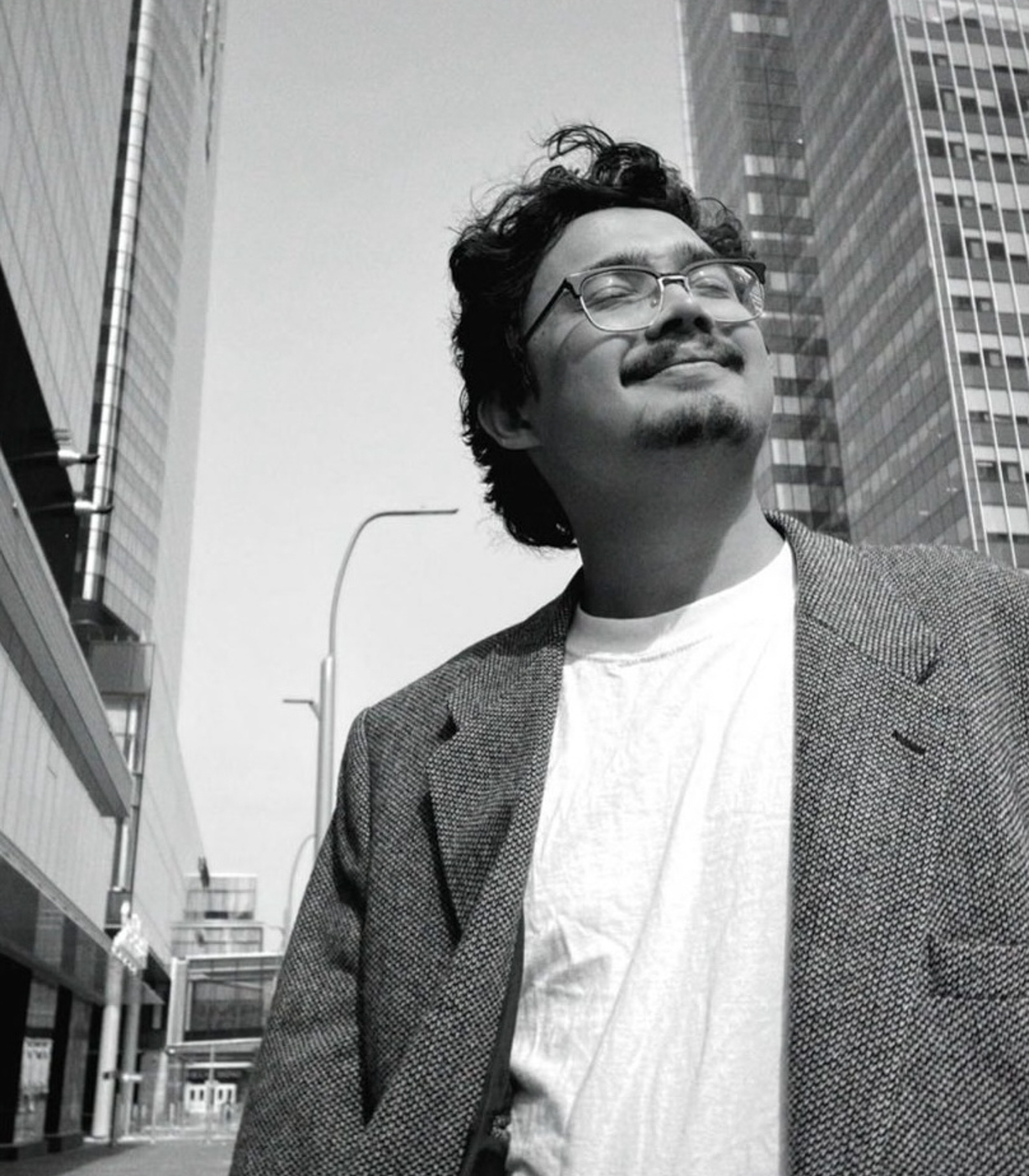
Raised between Saskatoon and Cairo, Noah Milo draws on personal experiences of migration in his artistic practice spanning painting, fashion and film. Working with oil paint and mixed media, he creates expressive abstract works that invite viewers to reflect on identity, community, and the spaces we share. Some of his works are currently on display on the TELUS Sky building screens as part of the Art While You Wait digital exhibition program.
300-square-foot studio
“I grew up in a very religious and conservative household. When I was 17, I was already into fashion and filmmaking, and art became my way to escape, a way to distract myself from feeling like I couldn’t be who I was.
“At the time, I was applying for grants, and I was lucky to receive one from the Alberta Foundation for the Arts. It helped me get on my feet. I was renting this 300-square-foot studio right across from my high school. Sometimes I could live there for free if I did extra work for the owner.
“That eventually turned into travelling between different studios and working under artists around the city. At one point, I was staying in City Centre Mall in Edmonton, right in the heart of downtown. I passed by a gallery there and met a Palestinian artist, Hanny Al-Khoury. I took his mentorship, unpaid, but in return, he gave me space to work. The studio eventually became my living space as well.
View this post on Instagram
“That experience shaped my The City Is a Problem series. Meeting people from different cultural, social and economic backgrounds gave me a lot of perspective on what I wanted to accomplish with my artistic practice. Art gave me the ability to focus on people’s experiences and to retell those stories.”
What is utopia?
“I’m working on a series called Solutions for the City, a follow-up to The City Is a Problem. That project came out of the years when I was transitionally homeless and hearing the stories of other people who were living rough. There, I began tracing common lines among marginalized communities in the city — whether by race, gender, class, or sexuality.
“I also curated an art show called Eyes on the Street, which brought together 16 local artists responding to the idea of the urban settlement city. The show helped me see how different people inhabit and experience urban space from very different perspectives. It also opened a dialogue about what it means to be Canadian living in an urban environment.
“What is utopia? What does an ideal city look like for the communities that live there?
“I think we often place the blame on individual behaviour, as if the person is the problem. But the places around us have a direct impact on our psychology. A hostile city creates hostile individuals. Renaturalizing cities [and] introducing more nature and more art can create spaces where people can heal.”
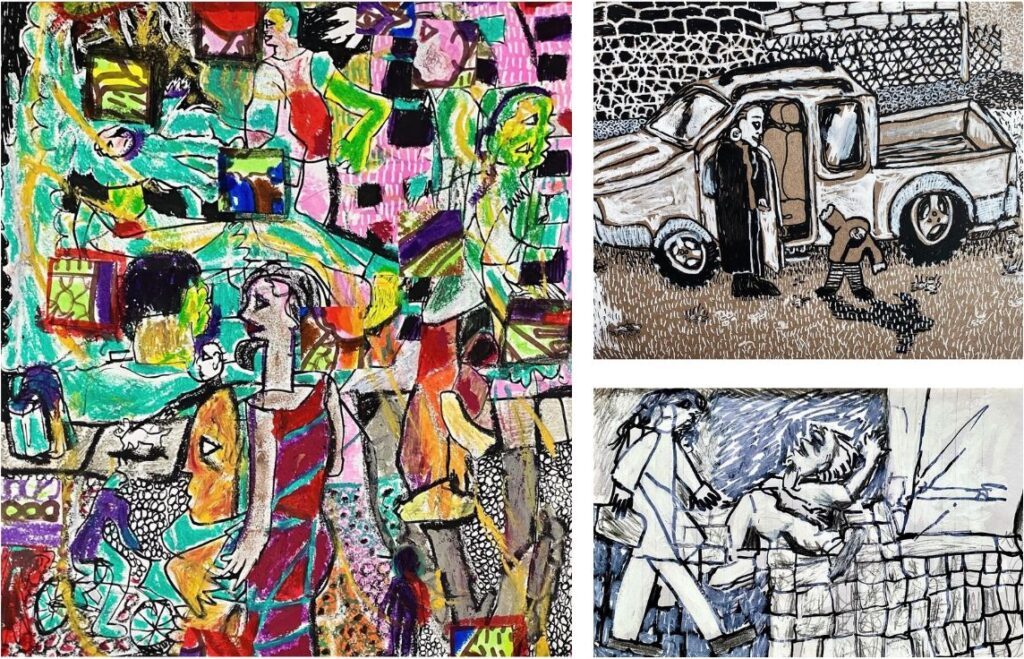
Outsiders
“I’m very inspired by graffiti culture and by that whole idea of making your mark in a space and claiming it as your own.
“From a formal art history perspective, I’m also influenced by abstract expressionism and German expressionism, especially the woodblock and printmaking practices from that period.
“There was a movement in Eastern Europe called CoBrA — artists who were influenced by the rawness of children’s drawings and the art of psychiatric patients. They definitely had an impact on me because I’m always trying to get back to the kind of creativity I had as a child. When you’re an amateur and learning something new, that’s when the most truthful ideas come out.
“Children are very sensitive to the world around them. As artists, we try to hold on to that sensitivity. For me, art becomes a universal language: if a kid can look at my work and connect with it, then I know it can resonate across generations.”
Jonas: fashion brand by Noah Milo & Yron Gerona
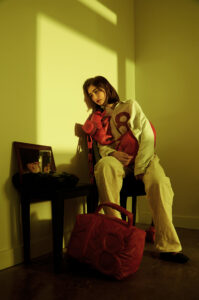
“[Yron and I] have been co-designers on the project since high school. It’s called Jonas after my little brother. At its core, it’s a streetwear brand, but it’s inspired by avant-garde runway fashion — designers like Rei Kawakubo and the work coming out of Comme des Garçons.
“The brand is structured around 19 collections. One day, I was crossing the street, and the pedestrian countdown started at 19. I thought: ‘What if I created a self-destructing fashion brand to limit the amount of work and waste produced by the line?’
“For Jonas, we centre the brand around upcycling materials. I still work at a fabric store, so a lot of the resources come from scrap bins or thrift stores.”
This Q&A was created in collaboration with Werklund Centre.
Noah MIlo: anewmilo.com | @anewmilo | @j.onas