Have you ever gazed longingly into the forlorn eyes of an equine? Have you experienced the depth and complexity of your mortal existence by bringing your heart rate in tune with a majestic steed? For us city slickers who grew up far from farm life, there is an inexplicable mystery about our equine friends. A mystery only horse girls, reckoning with the void, were brave enough to attempt to uncover. Horses: both free and caged, feral and domestic, calm yet dangerous. To contemplate horses is to attempt to understand ourselves and where we exist along the boundaries both inside and outside of nature.
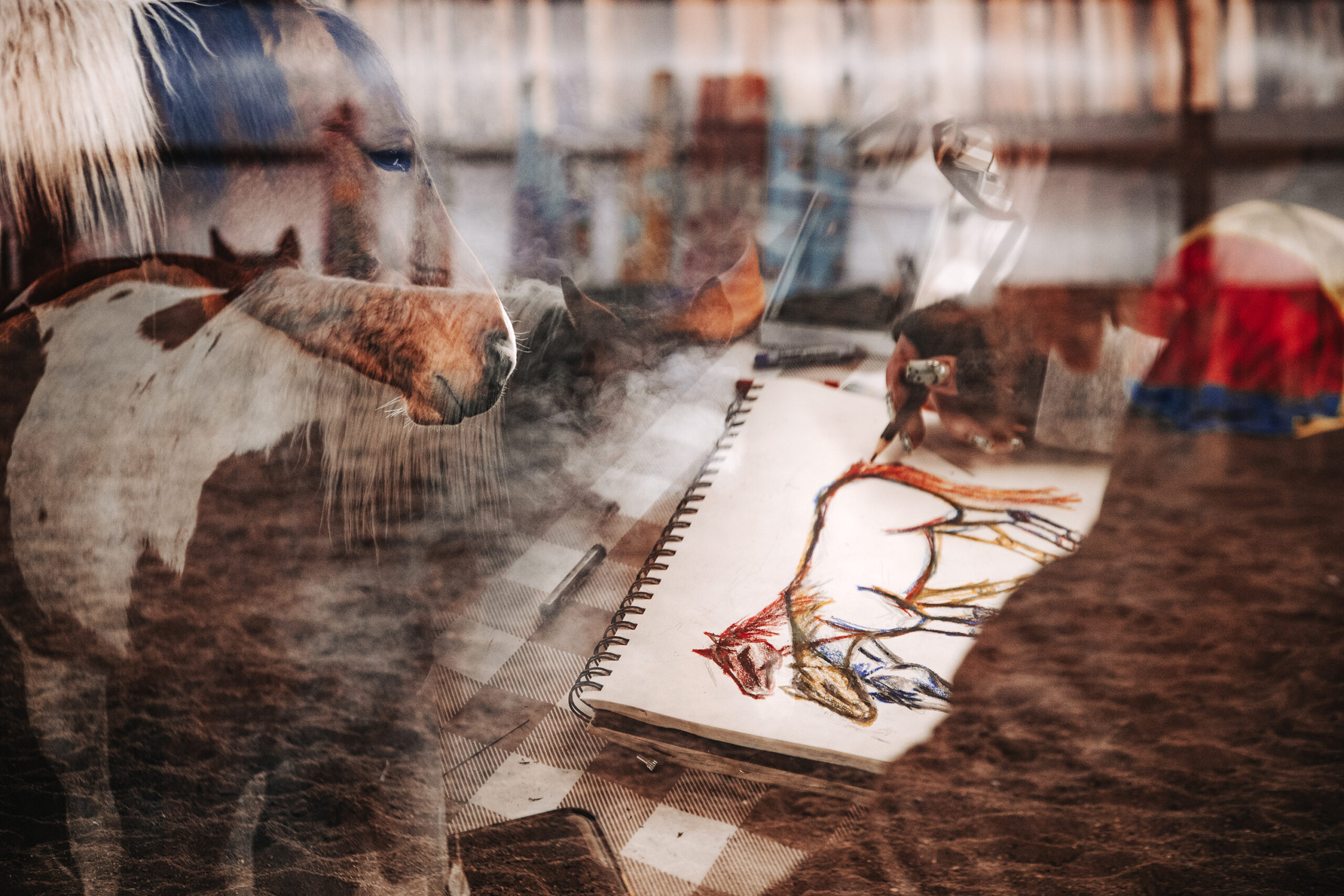
Local illustrator, horse girl revivalist, and self-proclaimed “stable boy” Geneva Haley has made horse-gazing an art practice, and it was in the act of slow-looking that she began to envision her workshop, Noticing: Building Observational Awareness Through Drawing Horses. It’s part of a wider cultural shift towards the “slow movement,” intentionally engaging in activities that bring our focus to a crawl in order to foster deeper, meditative understanding.
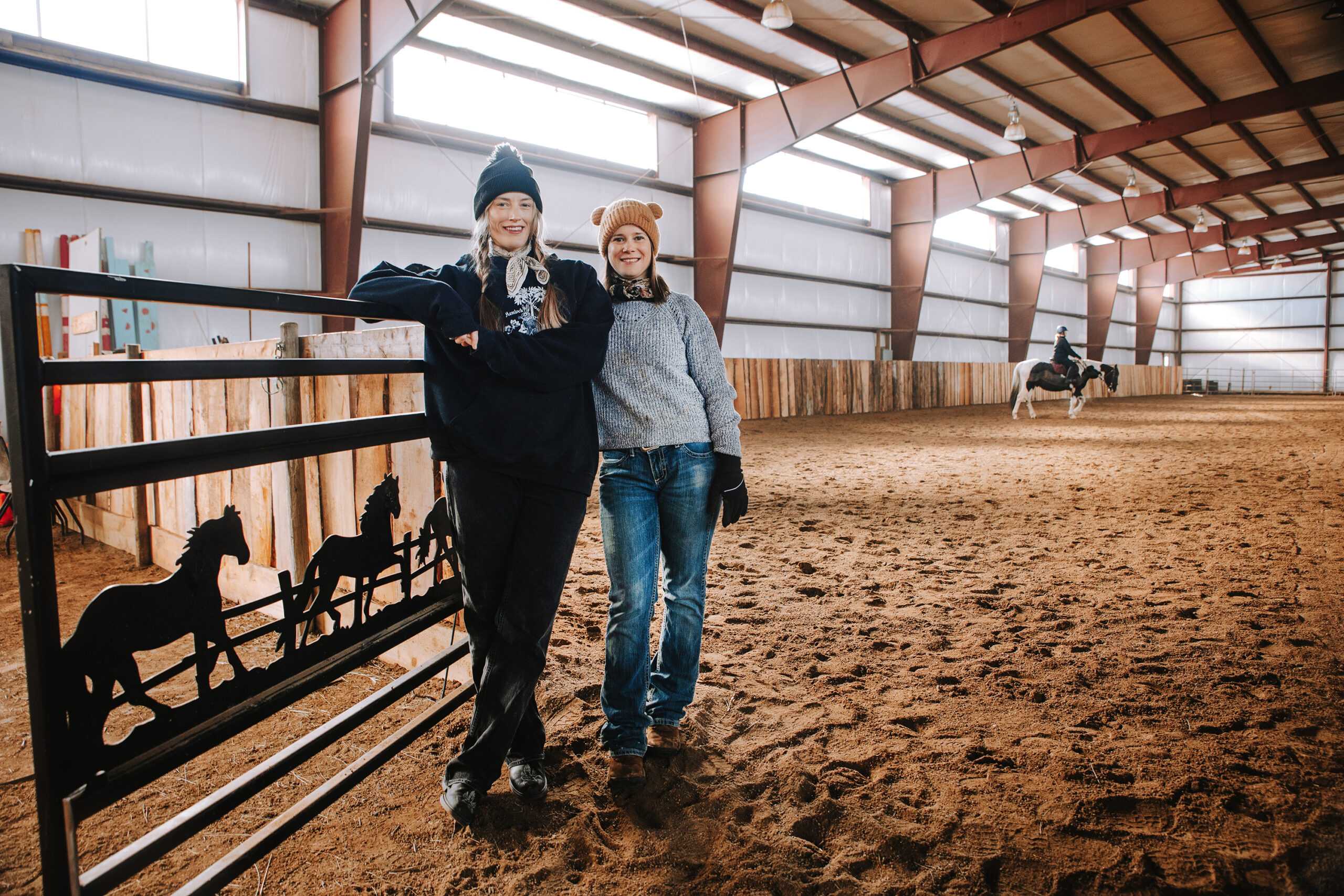
Driving north of the city on a bright winter’s morning, the act of “noticing” begins on the scenic journey to Open Door Farm. The Rocky Mountains carve out the horizon as acres of rolling snow-capped hills and idyllic farmlands pass by. Up the highway and down a winding range road, farm owner Jeanny Paquin wrangles three young horses into the barn ahead of the workshop. “The universe was telling me to do horses. But I did the office thing, and I went to school for something else,” says Jeanny, “I had this vision of a horse community in my mind. It was in me, and I was ignoring it.”
Slowly, Jeanny began inviting others into her vision, building a facility that houses over 50 horses amongst a colourful cast of barn cats, chickens, cows, and dogs. It was that same longing for nature that led Geneva to Open Door Farm. “I took paid lessons for a year. I shoved my toe in the door,” said Geneva, who, after landing a job working the stables, would spend her spare time curled under a tree for hours sketching the scenery. “I do love when people want to learn how to care for horses,” said Jeanny.
With Geneva’s inboxes practically overflowing with friends desperate to come out to the farm and Jeanny’s insatiable desire to educate an eager public, the idea for the workshop was born.
And word has certainly gotten around the pasture. On a serene Sunday in March, a small herd of humans gathered to experience three-plus hours of pastoral bliss, huddled together and engaging in quiet and oft-obtuse methods of observation. Geneva is careful to break down the initial butterflies — horses and humans alike aren’t quite sure what to do with themselves, but under her gentle tutelage and Jeanny’s calming presence, they begin to settle into each other. Comforted by mobile canine space heaters, Baguette and Brioche (a classic big dog/tiny dog combo), the impromptu illustrators sketch with abandon.
It’s not all art-making and galloping around the pasture with new friends. Both Geneva and Jeanny have ulterior motives: “I’m leading with drawing, with a basic practice of noticing, but the intended after-effect is mindfulness and being able to show up for the land a lot better,” said Geneva. “Getting adults to play is the key to getting them to be creative — it’s so good for your brain, your cognition, and your emotions.” Jeanny agrees. “I think horses are a great way to get people into mindfulness … you’re absolutely going to be a better human at the end [of the workshop].”
“I’ve been really trying to slow down and not let my brain turn to goo because of my phone,” said workshop participant Cleo. “I feel more relaxed today than I have in a really long time. Spending time with animals and studying how they move — it’s important to realize that we aren’t the centre of the universe.” The opportunity to create without an expected outcome is also central to Cleo’s experience. “It feels really good to practice. This is what’s so special about this class. It’s really accessible for people who don’t necessarily have experience with art and drawing.”
In our increasingly techno-tormented lives, nature is a salve for burnout and sustains our sanctity. Simply put: we yearn to return to the forest. To graze in the field. To frolic with merriment in the meadow. Horses intuitively understand this. They are teachers, with lessons in patience, consent, boundaries, curiosity, and the value of earned relationships. In this year of the horse, returning to a state of childlike wonderment can be therapeutic, and also softly radical.
“Horse girls like us are making a comeback,” Jeanny said. “Mindful horse girls are making a comeback.”
Learn more at pastureland.ca.